
How to Find a Reliable Residential Window Tinting Company Near You
If you live in Brentwood, Franklin, or anywhere in the Nashville area, you already know what Tennessee summers do to a home. The sun doesn't ease up from June through September, and standard windows do almost nothing to stop heat, glare, or fading from working their way through your glass. Residential window tinting is one of the most direct ways to fix that — but only when it's done with film technology matched to the actual conditions your home faces. The wrong film, the wrong install, or the wrong company can leave you with bubbling, peeling, or tint that turns purple inside of two years. This article walks you through exactly what to ask before you book any company for window tinting for residential homes in Brentwood, Franklin, or the surrounding area — so you make one good decision instead of two expensive ones.
What Residential Window Tinting Actually Does (and What It Doesn't)
A lot of homeowners come into this process thinking window tint is mostly about privacy or looks. Both are real benefits, but they're secondary to what good residential tint does for your home's thermal performance and your furniture's lifespan.
Modern window film works by blocking a significant portion of solar heat before it passes through the glass. It targets the infrared and ultraviolet portions of the light spectrum — infrared is what you feel as heat, ultraviolet is what fades your flooring, upholstery, and artwork over time. A well-chosen film stops both without turning your rooms dim or making your view look like you're peering through a tinted windshield.
Tennessee's climate makes this more complex than it sounds. You're not dealing with a single season of intense sun — you're dealing with variable conditions that shift from brutal summer heat to mild winters where you actually want solar gain. A film that's too aggressive in rejecting heat will work against you in January. A film that's too light won't do much in August. This is why film selection matters as much as installation skill. A company that offers you one or two film choices for every home regardless of window orientation, room use, or season isn't giving you the right answer — they're giving you the easy one.
This is the core tension in finding a reliable company: the shortcuts are invisible until months later, when the film starts to fail or your energy bills don't move the way you expected.
The Questions That Separate Careful Companies from the Rest
Before you book anyone for
residential window tinting in your home, there are a handful of questions that will tell you almost everything you need to know about how a company actually works.
Ask them which films they carry and who manufactures them. This isn't a trick question — a company confident in their product will answer it directly. Film quality varies considerably across manufacturers, and the best films carry specifications you can look up: visible light transmission percentage, total solar energy rejected, UV blocking rate. If a company can't or won't give you those numbers, that's a signal.
Ask how they approach window orientation. South- and west-facing windows take the most direct sun in Tennessee and typically need higher heat rejection. East-facing windows get morning light that's less intense. A company doing this correctly will walk your home or ask detailed questions before recommending film — not quote you a single option over the phone without knowing your layout.
Ask what the installation process looks like on the day of the job. Proper film application requires clean glass, controlled conditions, and time. Film applied to glass that hasn't been thoroughly cleaned will trap contaminants underneath. Film applied in direct sunlight or on a windy day is harder to handle and more prone to edge lifting. A company that rushes through prep is cutting the corner that causes the most visible failures.
Ask what happens if you're not satisfied with the result. The answer — and how confidently they give it — tells you a lot about how they stand behind their work.
Window Tinting for Residential Homes in Brentwood and Franklin — What Local Conditions Require
Brentwood and Franklin aren't just marketing territory — the conditions here shape what a good residential tint job actually looks like. Homes in this part of Williamson County tend to feature larger windows, open floor plans, and significant glass square footage. That's a lot of exposure when summer arrives.
Tennessee's summers run long and hot, with high humidity layered on top of intense UV index readings. That combination stresses film adhesives more than a dry-heat climate would. It also means the performance gap between a well-specified film and a low-grade one shows up faster. A film that might last adequately in a milder climate can start showing edge lifting or discoloration within a few years here if it wasn't designed for this kind of heat and humidity cycling.
At Corsair Pro, our residential window tinting film technology is specifically designed to handle Tennessee's intense summer heat and variable climate conditions — not just the peak of summer, but the full range of what this climate asks of a film across every season. That specificity matters when you're making a decision that's meant to last.
Homes in newer Brentwood and Franklin developments often have low-E glass already built into the windows from the manufacturer. Low-E glass has a factory coating that provides some baseline solar performance, and not all window films are compatible with it — adding certain films to low-E glass can cause thermal stress that cracks the glass over time. Any company you speak with should ask whether your windows are low-E before recommending a film. If they don't ask, ask them what they'd do if your windows turned out to be low-E. Their answer will be informative.
Red Flags to Watch for When Getting Quotes
The residential window tinting market has its share of companies that prioritize volume over quality. Some patterns are worth knowing before you start making calls.
Be cautious of any company that quotes you a price without asking about your windows. A real quote requires knowing the number of windows, the glass type, the square footage, and ideally the orientation of the rooms. A quote given without that information is a number designed to get you to call back, not a real estimate.
Be cautious of very low prices presented as a straightforward deal. Film cost varies by quality, and labor cost varies by how carefully the job is done. A company operating significantly below the market rate in Brentwood or Franklin is cutting cost somewhere — usually in film specification, prep time, or both.
Be cautious of companies that don't offer a consultation or site visit before the job. A home isn't a generic surface. Window orientation, glass type, interior use of each room — all of it should inform the film recommendation. Companies that skip this step are making assumptions about your home that could lead to a film choice that underperforms or fails early.
Also pay attention to how clearly they communicate. A company that can explain what a film does, why they're recommending it for your specific windows, and what the installation process looks like is a company that knows what they're doing. Vague answers to direct questions are a pattern worth noting.
What a Good Installation Day Actually Looks Like
Knowing what to expect on installation day helps you evaluate whether the job is being done correctly while it's happening — not six months later when a problem becomes visible.
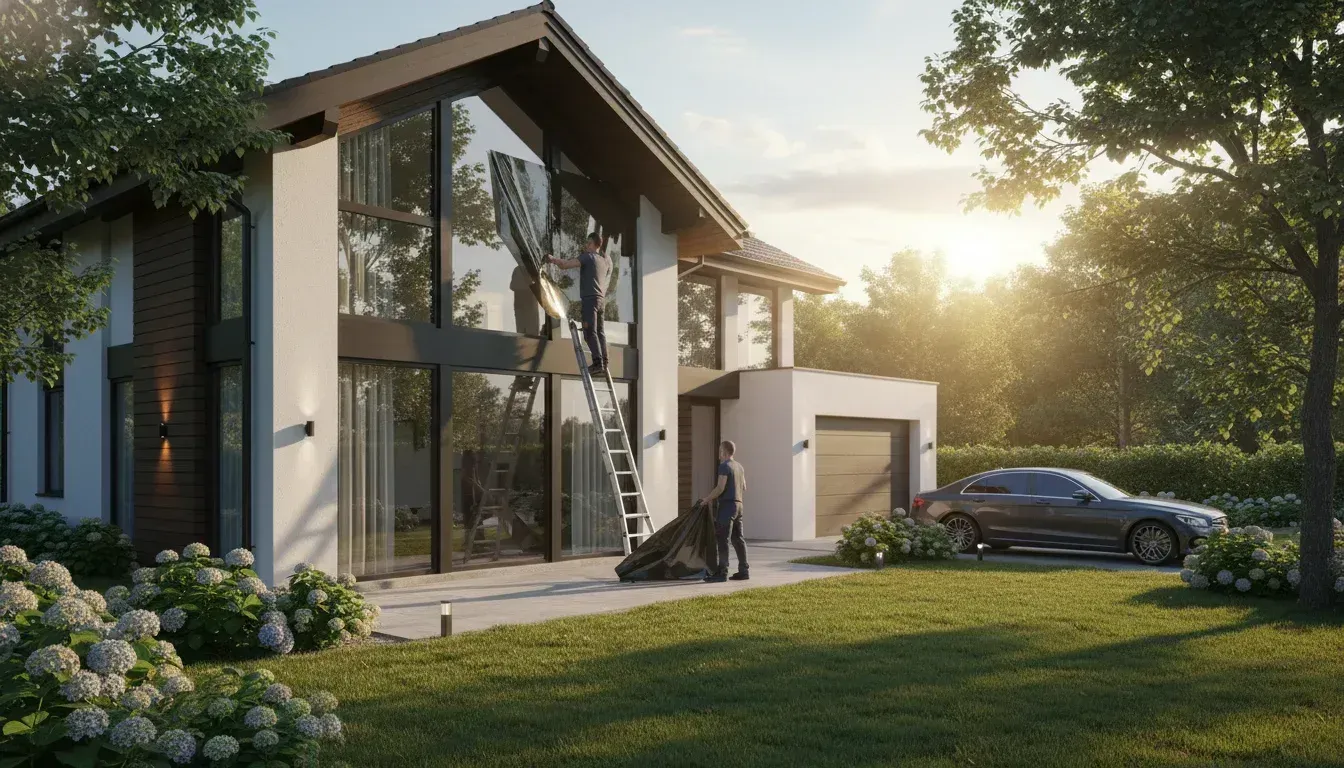
The installer should start by cleaning each window thoroughly. This typically involves a cleaning solution and a squeegee, and it takes real time to do properly. If someone moves quickly through this step, that's worth noting.
The film is cut to fit each pane. Precision here matters at the edges — film that's cut too short will leave a visible gap; film that's cut too long gets folded against the frame and lifted. A careful installer takes time on each cut.
Once applied, the film goes on wet. A slip solution allows the installer to position the film accurately before pressing it into final position with a squeegee. Air and water are worked out from the center toward the edges. Small water pockets visible immediately after installation are normal and typically clear within a few weeks as the film fully cures — a good installer will tell you this upfront so you're not alarmed.
After the film is set, the installer should walk the job with you, point out anything worth knowing about the cure period, and leave the glass clean. If that final walkthrough doesn't happen, ask for it.
How to Make the Right Call for Your Home
Finding the right company for window tinting for residential homes in Brentwood, Franklin, or anywhere across Middle Tennessee comes down to a simple principle: a good company knows more about your home before the job than a bad one knows at the end of it.
The questions in this article aren't obstacles — they're the fastest way to tell which companies are worth your time. A company that answers them directly and specifically is demonstrating the same approach they'll bring to your windows.
At Corsair Pro LLC in Brentwood, we work with film technology built for Tennessee's climate from the ground up. If you're ready to talk through what your home needs — the windows, the orientation, the film options — reach out and we'll walk you through it. That conversation costs you nothing and tells you everything you need to make a confident decision.